Game guide · Route planning
Reading Super Metroid as a Route-Planning Problem
Super Metroid’s interconnected exploration is easier to understand when each blocked passage becomes a question about route, ability and memory rather than a simple dead end.
By the Daniel Mercer
Published
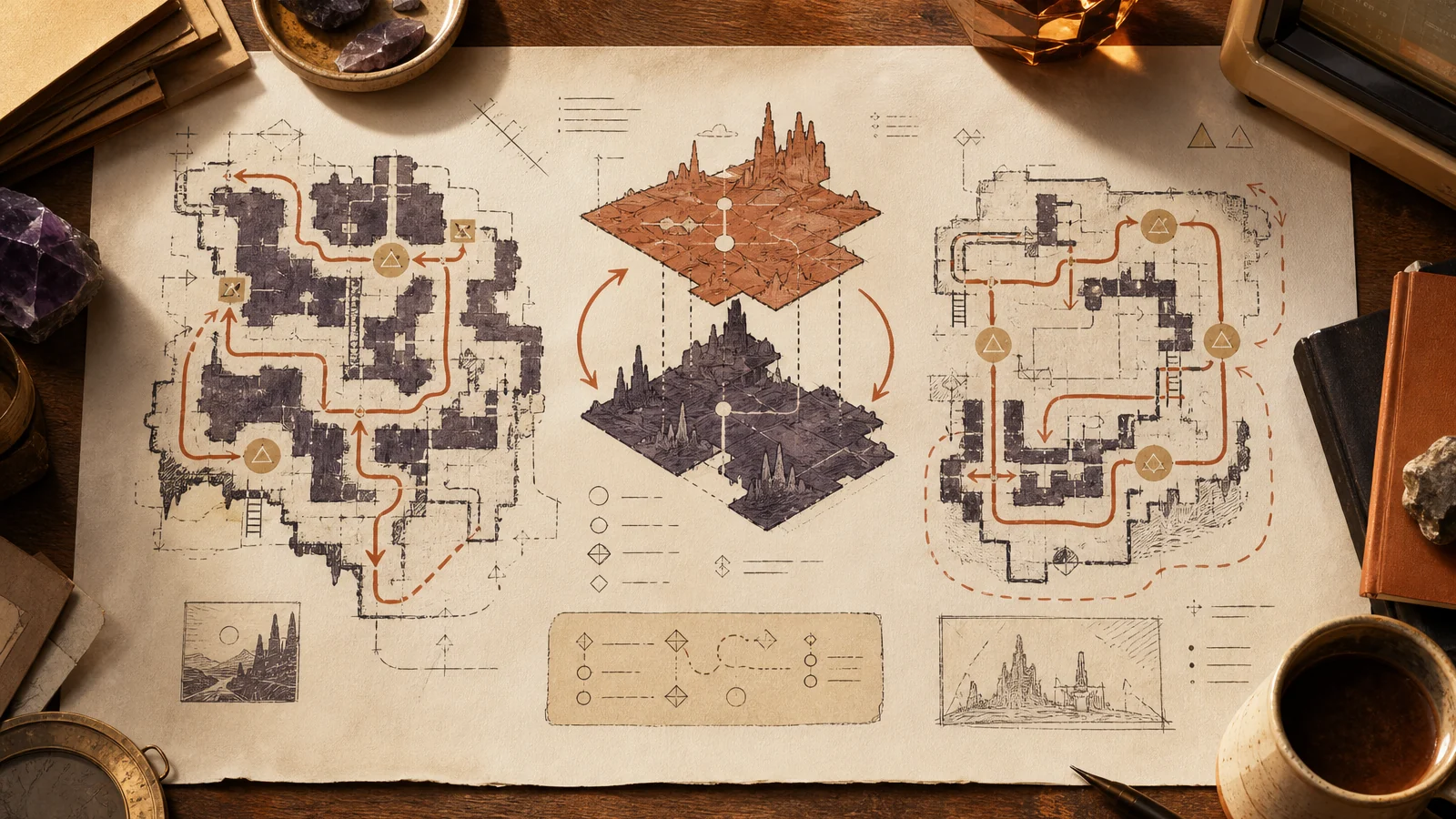
Spoiler note: This guide discusses progression logic, ability gates and backtracking without revealing late-game locations, major progression turns or story-sensitive details.
Super Metroid is a 1994 action-adventure game for the Super Nintendo Entertainment System. Its interconnected exploration, ability-gated routes and map-led progression make movement part of the central design question: where should you go next, and what suggests that the answer has changed?
What route planning means here
A straightforward walkthrough can turn a connected world into a list of instructions. A route-planning approach keeps the structure in view. It asks you to notice which paths are available now, which an ability blocks, and which earlier spaces may be worth revisiting when your options expand.
That distinction matters because a blocked route is not necessarily a failed route. It can be a signpost. Note what kind of obstacle you found, then return to the wider map instead of testing the same entrance again without a new reason.
Treat ability gates as questions
Ability gates divide the world into short-term possibilities and longer-term destinations. When a passage asks for something you do not yet have, the immediate fact is simple: that route is not part of the current solution. The more useful question is what the gate tells you about the shape of the world.
One useful approach: keep a compact note of the gate’s location and its visible characteristics. You do not need to turn every obstruction into a detailed checklist. A brief reminder is enough to make future backtracking purposeful: the route exists, the requirement is clear, and the map can now hold that information for you.
Use the map as working memory
Map-led progression takes the pressure off remembering every corridor perfectly. It also changes how exploration feels. Instead of asking only whether a room has been visited, ask what the visit established: an unopened route, an unfamiliar branch, a connection between areas, or a space that may respond differently after an ability change.
This is where memory and mapping work together. The map records structure; your notes or recollection supply the reason to return. When those two layers agree, revisiting an earlier area feels less like repetition and more like testing a new route hypothesis.
Backtracking is part of the explanation
Backtracking can look like wasted movement when a route is judged only by how directly it reaches the next objective. In Super Metroid, the return journey can instead show how the world stays connected as your available options change.
Editorial view: the strongest route is not always the shortest route. A readable route is one that leaves you with a reason for each turn. If you are returning because a new ability changes the meaning of a known gate, the detour has a clear purpose. If you are wandering without a remembered question, pause and re-read the map before choosing another direction.
A practical loop for uncertain moments
- Identify the current question. Is the problem a blocked passage, an unexplored branch or uncertainty about where the map connects?
- Separate the known from the possible. Mark routes that are clearly unavailable, then consider which accessible spaces could change your options.
- Choose one reason to move. Follow a route because it tests a specific idea, not simply because it is the nearest unvisited corridor.
- Update your map memory. After the attempt, keep the useful result: a new connection, a confirmed gate or a reason to defer the route.
This loop keeps the guide practical without pretending that one sequence suits every player. Some readers will prefer a tightly recorded route; others will use the map more loosely and let curiosity lead. The common thread is recognising that the game communicates through connections, restrictions and returns.
The route is the lesson
Super Metroid’s ability gates, map memory and backtracking do more than provide navigation tools. Together, they turn exploration into a readable route-planning problem. You are not only moving through connected spaces; you are learning to interpret a world whose possibilities change over time.
That is the useful perspective to carry into a walkthrough: do not ask only what comes next. Ask what the current route is communicating, what earlier information still matters, and which approach makes the next decision clearer.