Mechanics comparison · Spoiler-aware walkthrough
How A Link to the Past Reframes Familiar Spaces
The Legend of Zelda: A Link to the Past turns travel into a question of perspective. Its overworld, dungeons and two connected worlds ask the player to reconsider places that appear familiar, then use that revised understanding to make the next route easier to read.
Published by the Daniel Mercer.
Published
Spoiler note: This article discusses the game’s two-world structure and its effect on progression. It avoids specific late-game locations, endings and story-sensitive reveals.
Begin with the shape of the problem
The Legend of Zelda: A Link to the Past is a 1991 action-adventure game for the Super Nintendo Entertainment System. Its structure combines an overworld, dungeons, puzzle solving and movement between two connected worlds. That combination makes the game’s central question broader than “Where should I go next?” A more useful question is “Which version of this space, and which kind of route, is relevant now?”
That shift matters because the world is not only a sequence of destinations. It is also a set of relationships. An overworld route may establish a landmark, a dungeon may turn that landmark into a puzzle clue, and movement between the connected worlds may change what the player thinks the space is for. The design therefore rewards careful observation without requiring every decision to be treated as a single correct answer.
The overworld gives memory a practical role
Overworld travel gives the player a broad spatial frame. Paths, entrances and recognisable areas become reference points that can be revisited in a different context. The important skill is not simply remembering a location; it is remembering what kind of decision the location presented last time and what remains unresolved.
One useful approach: treat each return as a fresh comparison. Ask what has changed, what is still blocked and whether the next sensible move is exploration, puzzle solving or travel to the other world. This keeps route planning flexible. It also prevents a familiar screen from becoming a dead end in the player’s mental map.
Dungeons narrow the question
Dungeons provide a more concentrated version of the same design language. Where the overworld offers several directions and broad landmarks, a dungeon places movement and puzzle solving into a tighter sequence of rooms and decisions. The player is asked to connect local clues with a larger route through the space.
That contrast between overworld and dungeon helps explain why the game’s spaces feel related rather than interchangeable. The overworld supports orientation and long-distance planning. The dungeon tests how that orientation works when doors, obstacles and puzzles limit the available choices. A guide can describe these as separate layers, but the player’s understanding improves when the layers are read together.
Two worlds, one shifting mental map
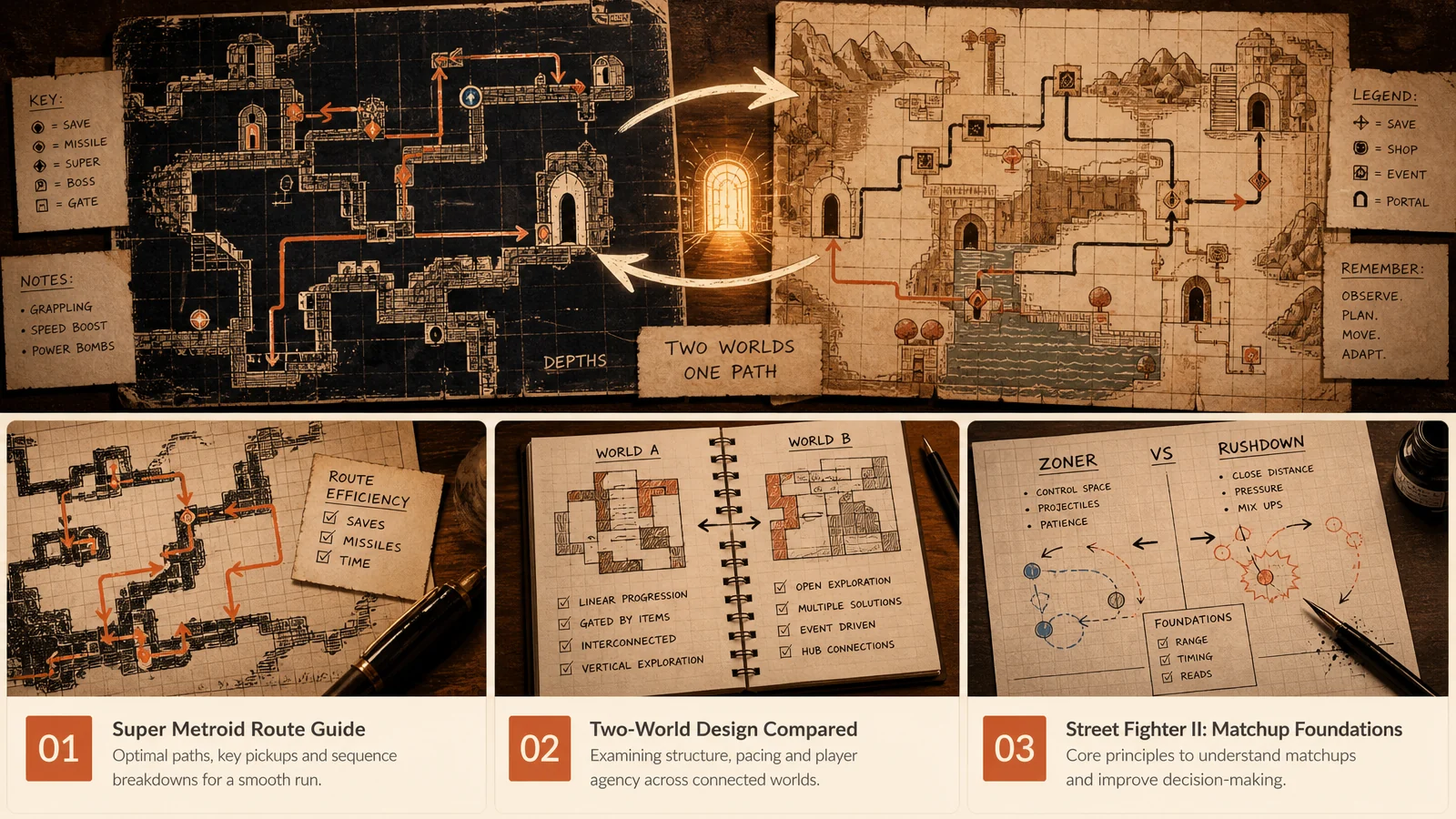
The two-world structure reframes familiar spaces by placing movement and recognition at the centre of progression. A place is no longer understood only by its visible layout. It can also be understood through its relationship to a corresponding place in the other world, and through the different travel decision that relationship creates.
Editorial view: the most interesting effect is not novelty for its own sake. The structure turns memory into an active mechanic. A player who has learned the broad arrangement of one world can use that knowledge to ask better questions about the other: Is this space a destination, a shortcut, a puzzle prompt or a clue about how the two worlds connect?
This approach also gives backtracking a purpose. Returning to a known area is not simply repetition when the relationship between spaces has changed. The route may be the same while the question is different, or the destination may be familiar while the decision about how to reach it has shifted.
A practical comparison for route planning
When reading the game as a route-planning problem, three approaches are especially useful:
- Landmark-first: use the overworld to identify recognisable places and unresolved entrances before committing to a direction.
- Puzzle-first: focus on the immediate dungeon problem, then connect its solution to the wider travel map.
- World-pair thinking: compare corresponding spaces across the two connected worlds and ask what the contrast changes about movement or access.
None of these approaches has to replace the others. Landmark-first thinking helps with orientation, puzzle-first thinking keeps local challenges manageable, and world-pair thinking explains why a familiar route can serve a new purpose. Together, they give shape to decisions that might otherwise feel like wandering.
What the structure teaches the player to notice
The game’s lasting lesson is that spaces communicate through repetition and contrast. The overworld establishes a broad route, dungeons sharpen the player’s attention, and the two-world structure invites comparison. Progress comes from combining those signals rather than searching for one universal route.
That is why a clear walkthrough should explain relationships, not just directions. Listing where to go may solve one moment, but explaining why a place matters helps readers build a reusable map of the game’s decisions. For players who prefer fewer spoilers, the same framework can be applied gradually: identify the system first, then reveal only the route detail needed for the next choice.
Explore the publication’s other editorial subjects in all guides, comparisons and walkthroughs, or learn about the Daniel Mercer.